Hi, I'm Róisín, a senior product designer driving growth in AI products.

Senior product designer in Growth, currently focused on self-serve acquisition and activation at Fin (formerly Intercom). Nine self-serve projects this year, two A/B test wins, and an AI demo that lifted leads by 23%.

Selected work

2026

More 2026 work

In build and in test

Also in progress: five more projects across onboarding, activation and settings, from live A/B tests to prototypes.Unlock to see them

Earlier work

2019 — 2025

2024–25 · Fin (formerly Intercom) · Design lead

Early Stage progression

The problem

Startups on Fin’s programme get a big discount for their first three years. But few moved from year 1 to year 2, and those who did were often unhappy about it. Research showed why: at renewal, we moved customers onto a plan they hadn’t chosen, and that might no longer fit them. Nothing in the product told them it was coming, and there was no alternative on offer.

What I did

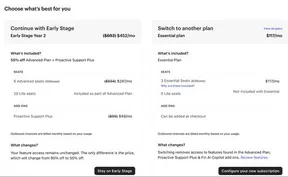
I redesigned progression as a clear choice, across email and the product:

  • A reminder email 30 days before the discount changes, showing the new price and linking straight to their options.
  • A choice on the billing page: continue with Early Stage, or switch to another plan, with what’s included and the price side by side.
  • A plan builder for customers who switch, so they can pick a plan and seats and see the total before confirming.

The result

137% more customers made a deliberate choice at renewal, and 74% more knew their options beforehand. Renewals and sentiment both went up.

2024–25 · Fin (formerly Intercom) · Design lead

Email setup

The problem

Only 14% of new customers who visited email setup ended up ready to use it. The old page put six technical steps on one screen, sent people off to their email provider with little help, and mixed forwarding and domain setup together.

What I did

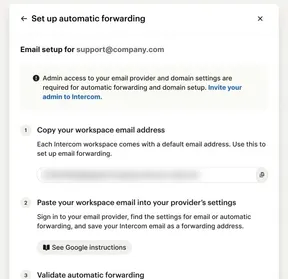
I restructured setup into four clear steps: add your address, set up forwarding, authenticate your domain, done. Each step has guidance for the person’s email provider, help content built into the product, and a clear note when they need an admin, so people could finish without leaving to read docs.

The result

2× as many people attempted setup, and 24% more tested it successfully.

2023 · Fin (formerly Intercom) · Design lead

Trial higher plans

The problem

Customers who hit a paywall could only upgrade by buying straight away or chatting with sales. Plenty wanted to try a higher plan first, and the sales step lost them.

What I did

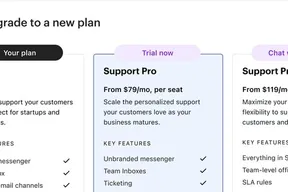
I redesigned the paywalls around “Start your 14-day free trial”. The upgrade modal shows the current plan, the plan you can trial now and the next tier up, and a side panel explains exactly how the trial works: start today, a reminder on day 12, and what happens on day 14.

The result

Plan trials rose ~41%, and overall conversion rose from 11.6% to 13.1%.

2022 · Fin (formerly Intercom) · Co-lead

Billing blueprint

The problem

Customers were surprised by invoices, and no single team owned billing.

What I did

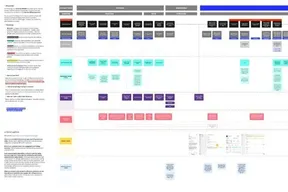
I co-led the research and built a service blueprint across every touchpoint, from purchase to cancellation: what customers do, what they see, and what happens behind the scenes.

The result

The blueprint shaped the first roadmap for a company-wide initiative to fix billing. It showed that the worst moments weren’t always about price; they were the points where customers had to ask someone for help, or got a bill they didn’t expect.

What it led to

That finding set the direction for my next four years of work: letting customers trial higher plans without sales (2023), a clear choice at Early Stage renewal (2024–25), and switching plans during the trial (2026).

2020–21 · Verizon Connect · UX and service designer

Verizon activation

The problem

79% of vehicle tracking installs needed a Verizon technician, and customers waited an average of 58 working days from sale to install. The goal was more customer-managed installs, and a faster route to using the product.

What I did

  • Led internal research with sales and onboarding teams, and supported customer research. It surfaced the blockers: no incentive for sales to offer self-install, 15 working days just to gather vehicle details, 30+ steps to choose equipment, and no help for customers installing themselves.
  • Built a service blueprint and a persona playbook (Vince the organiser, George the installer, Jayden on the onboarding team), and walked stakeholders through the as-is journey to prioritise pain points together.
  • Ran ideation with the cross-functional team, developed three concepts, and turned the chosen direction into a to-be journey and a storyboard for stakeholders.
Service blueprint of the sales-to-install journey, with the key pain points called out
Persona playbook: the people involved in getting a fleet installed
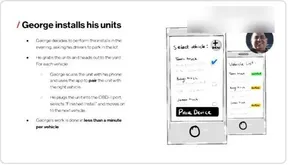
Storyboard of the to-be journey, from sale to a fleet up and running in Reveal

The result

Customers testing the concept found it usable and a good fit for distributed fleets, and the work earned me a Verizon Innovation Award.

Looking back

We underestimated the barriers to installing through an app, and brought other product lines in too late, which caused friction in roadmap planning later.

2019–20 · Verizon Connect · UX designer

Driver-facing camera

The problem

Fleet managers using Reveal couldn’t see what led up to an incident. That made it hard to coach drivers on safety or respond to claims about their driving, and sales were losing deals without a driver-facing camera.

What I did

I worked in a cross-functional team as the UX designer, and led the work from research to detailed design:

  • Ran workshops to build out Marv, our fleet manager persona, with empathy mapping and user stories.
  • Mapped Marv’s as-is journey from sale to installation, then validated our assumptions with stakeholders.
  • Facilitated a cross-functional sketching session, developed and tested concepts with our researcher, and supported a proof of concept for picture-in-picture video.
  • Designed the detailed mobile and responsive web experience.
Running the cross-functional sketching session
Concept sketches: switching between road and driver view, and reviewing an incident on mobile
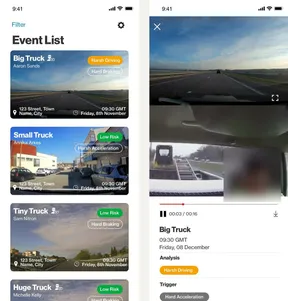
Mobile designs: the event list, side-by-side road and cab video, event details, and the empty state
Responsive web: the event view with both camera feeds, analysis and location

The result

After launch, video became the company’s fastest-growing product, and customers gave very positive feedback about its impact on driver safety.

Looking back

We should have brought the hardware team in earlier. The project also showed that installation wasn’t joined up across products, which led straight into my next project.

Unlock the case studies

One password opens all four. Don’t have it? Email me and I’ll send it over.

Writing

Feb — Apr 2026

A 9-part series on learning to build with AI as a designer, from returning to work to shipping my own apps with Claude Code.
Read the full series on Substack